
Today I am called by something in my heart to write this blog post. These are some of the books that have helped me to:
- notice my patterns
- be the observer of self
- realise I am part of something much bigger
- understand my conditioning
- heal parts of self
This isn’t a list of “the best self-help books.”
It’s a list of books that I found at exactly the right time.
Some of them I haven’t picked up again in years. Some I might read today and feel completely different about it.
But at the time, each one quietly shifted something in me.
Books that I found at the right time.
My ‘to-do’ list for today that I hastily wrote last night felt ‘off’. There was something about it that was frustrating to me. Unable to put my finger on it, I took myself to bed. Knowing only too well that a full and scrambled mind is always seeking sleep, not resolution.
When I woke up this morning, it all fell into place. I noticed a default pattern of mine that has dominated the way I operate my life. Until today. The problem with that list was threefold.
Firstly, it was full, oversubscribed (I would never satisfactorily complete the things in a day). Secondly, everything was written on it with a sense of necessity & urgency (let’s be honest, the reality is, I’m not a surgeon, it can all wait in reality). Thirdly, because of these first two things, by the time I got to writing tasks to do for this business, my business, instead of my part-time work, I knew there was no point.
I had filled the list with work for others, before the work I wanted to do for myself, to further my own dreams and desires. When I witnessed this fact, a whole stream of other moments in the past week alone flooded into me. My urgent need to finish ironing the two lonely shirts in the bottom of the basket that my partner started before he came home, despite having other things that are more important to me. The compulsion to listen and reply neatly to all the voice notes and messages from friends before I would entertain sitting down to my own work.
You see, it seems my work doesn’t have a great deal of space to breathe. I don’t give it the oxygen it needs to really flourish. I keep a cap on it and choose to put it at the end of the day. When I’m tired and my energy has gone elsewhere. But no more.
One thing I love about myself is that once I’ve spotted a patten not serving me, that’s it. I’m not prepared to continue to play a game that doesn’t feel fun for me. So, another level of ‘good girl’ conditioning has been spotted, and it’s shifted the day entirely. I have moved from trying to complete 20 things for someone else, to grounding myself in action that feels true to my heart.
Hence, this blog. I walked into my office, looked at my shelves and wanted to share some of the books that have helped me on this journey of being more me. The path to being able to observe myself and ‘do the work’, so that putting myself and my work, dreams and desires first, doesn’t feel like some kind of criminal act.
So, let’s dig in!
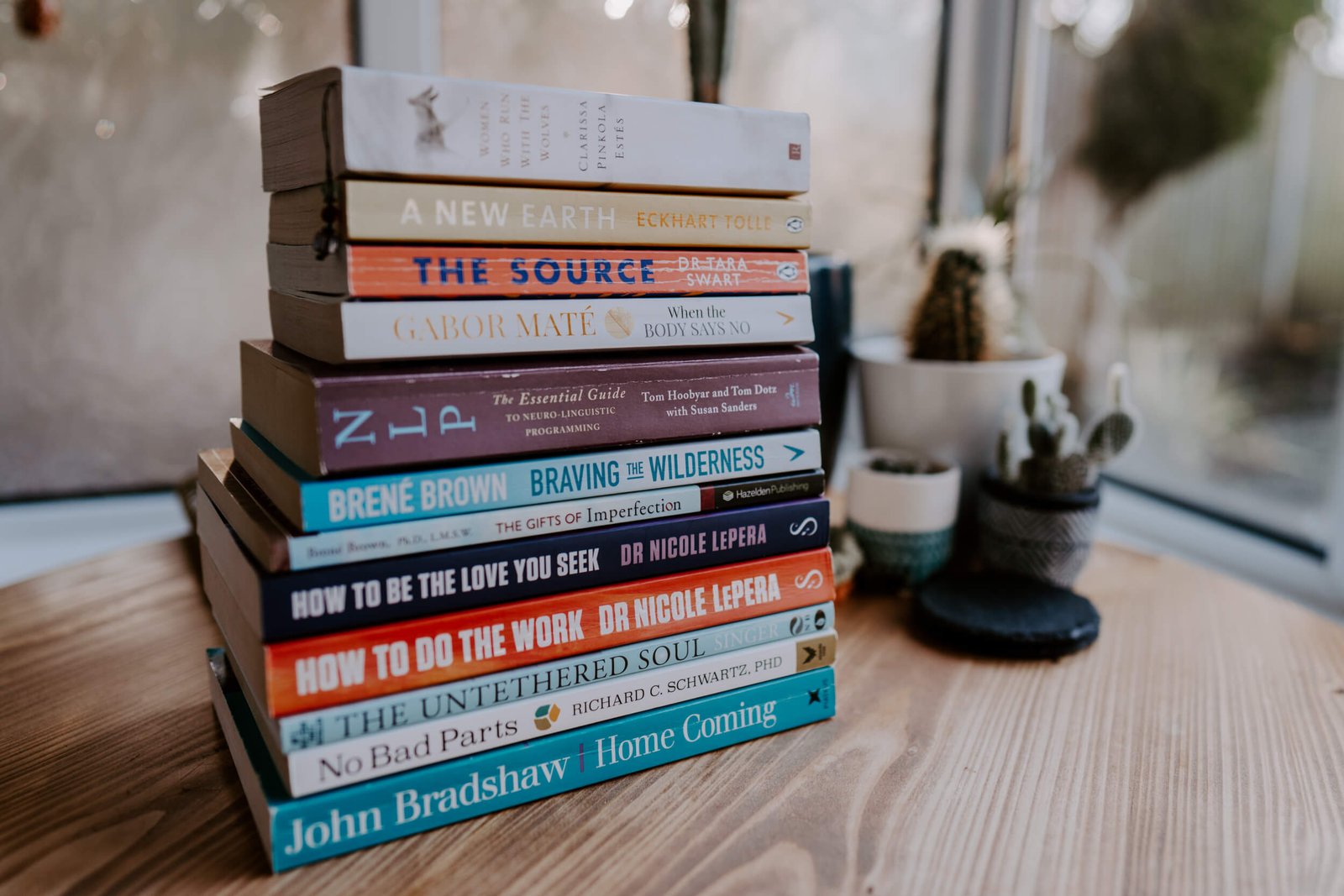
Brené Brown – The Gifts of Imperfection
This was the very first ‘self-help’ book I read in 2017. I embarrassedly picked it up after my first ever coaching session. That first session introduced me to the concept of vulnerability, since my ‘homework’ was to go away and watch the viral Brené Brown Ted Talk on said topic. At the time, it was a concept I found to be genuinely disgusting, let alone as something I would be able to practice in my life. (Me? Asking for help? Me? Sharing my feelings? I’m sorry, but no.)
The fact I was having such strong reactions to an idea others felt more comfortable with, told me I had some work to do. It was this work that started to change my life. Fast forward to today and vulnerability and I are, thankfully, two peas in a pod.
This book lovingly slapped me in the face with every single ‘good girl’ pattern I was running on. I was eating perfectionism for breakfast, lunch and dinner (both metaphorically and unfortunately, I literally had a very unhealthy ‘healthy’ relationship with food [read: disordered relationship]).
My life was primarily concerned with what other people thought of me and as a result I was constantly ‘shoulding’ on myself, through the jobs I was working and how I was spending my free time. My self-worth wasn’t great, and anxiety was most certainly in the driving seat.
It’s been 9 years since I first opened this book and I haven’t read it since, so I’m not sure what I would think of it today. However, at the time, as my first ‘self-help’ book, it spoke volumes to me. It laid out everything to me as if I was looking in the mirror, and I felt seen in a way I hadn’t previously felt. I think for the first time, that feeling that I was the ‘only one’ feeling the way I felt, dissipated.
What it gave me:
It introduced me to a whole new world. Language that felt like it witnessed me. Concepts that I had previously had never even been in my sphere. Or if they had, my eyes were firmly closed to them.
Dr Nicole LePera – How to do the Work
It’s 2021 and I have been a big fan of following @the.holistic.psychologist on instagram for a while at this point and this was, I think, her first book. At this point in my life, I was in the throes of turning over all the stones I could find. I was deeply interested in my patterns and behaviours, keen to pick them all up one-by-one, analysethem and heal them. Honestly, it was quite an exhausting era, albeit, very necessary for me.
Through working with another coach & hypnotherapist, as well as frequenting cacao ceremonies, breath work sessions and the like, I’d already got quite a lot of excellent tools in my bag to do ‘the work’. I was journaling in a wholesale kind of way, my hand was on my heart a lot of the time, and I was learning deep self-compassion.
I remember feeling completely out on a limb and occasionally quite embarrassed by how much I wanted to turn my attention inward. There was almost a compulsion to “get the job done” (which is, in hindsight, hilariously on brand for me). I felt overflowing with questions, insights and emotions, and I wasn’t always sure what to do with them. I’d even found a new group of girl friends who were also spending time in these same spaces (as you can see, I’ve fully got out of my own way at this point regarding vulnerability because is there anything more vulnerable than trying to make new pals as an adult?!).
This book was the perfect companion for this era because it gave me confirmation. Over and over again, it affirmed that I was on the right path. As I was reading it, it was echoing the practices I was already using. I was reading along thinking “yes! that’s almost the same as what I have already been doing”. On top of that, the book held up a mirror and helped me to feel seen in my patterns and behaviours. I couldn’t get enough of feeling witnessed and not alone. Because the healing work can feel that way when you’re not in the world of others having a similar experience.
What it gave me:
A level of reassurance that I was on the right path for myself. A momentum in knowing I wasn’t alone on this journey.
Richard C. Schwartz – No Bad Parts
Now then, this book was an absolute BABE. Honestly, kind of gutted it was written by a man, but alas. This guy is a genius to me, and the concepts and practices in this one changed my life in the most profound way.
At this point, I’ve gone from someone who had their eyes closed to the concept of vulnerability, to someone who had their eyes so wide open to it, that they felt a little bit crazy. To someone who picked up this book and was able to learn to stop fighting with myself in a really practical way,
Throughout this whole time, I have loved the work of Dr Kristen Neff – she writes, speaks and teaches self–compassion. For me, it was like this book by Richard Schwartz gave me practical guidance on how to put self-compassion into place. It just made perfect sense to my brain, and everything felt like it slipped (albeit in a jagged, painful, hard work kind of way) into place.
It was the first time I truly understood that the parts of me I had spent years trying to silence weren’t bad at all.
They were trying to help.
Trying to protect me.
Trying to keep me safe in the only way they knew how.
That changed everything.
I could have a conversation with all parts of me around a table, one that leads with self-compassion, vulnerability, and love at the forefront.
What it gave me:
A way to apply everything that I had been learning, to myself. It felt like a grounded conclusion to everything I had uncovered and peeled back was able to settle down to its rightful, aligned place within me.
In conclusion…
Books don’t change our lives. We change our lives. Sometimes a book simply arrives at the moment we’re finally ready to hear what it has to say.
Perhaps you’ll read one of these and love it. Perhaps you’ll put it back on the shelf for another year. Both are okay.